
JESUS’ TIMES
Jesus lived in turbulent times.
It was just a hundred years before his birth that his region, (Galil Goyim means ‘Region of the Gentiles’) was conquered. The brutal Jewish king Aristobolus I forcibly converted the population to Judaism. Settlers from Judaea in the south helped the transition.
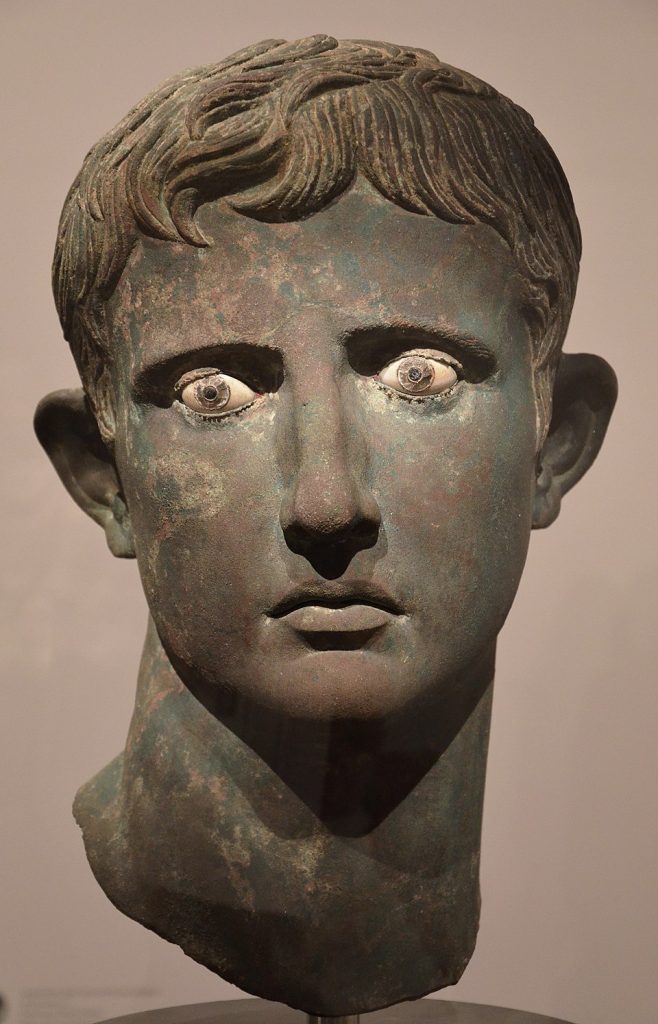
While still a toddler, Herod I died, deeply unlamented. In his final will he made his eldest son Archelaus ruler of Judaea and Samaria, and his younger son, Antipas, ruler of Galilee. There was a political vacuum while the various claimants journeyed to Rome to have Augustus decide on the succession. Jesus described this in some detail in the parable of the ten pounds (Luke 19.11-27). During this unsettled time there were various revolts. Jesus’ village of Nazareth was just five miles from the new fortress town of Sepphoris. According to Josephus, Judas the Galilean got hold of the armoury there and raised a revolt. This ended with the city being set on fire and the population enslaved. Nazareth must have been inundated by refugees.
Head of Augustus
In Rome a delegation of fifty Jews appealed to Caesar not to make any of Herod’s family rule over them. Instead they asked that Herod’s kingdom be incorporated into the Province of Syria and be ruled directly by the Roman legate. But Caesar chose to honour Herod’s last will and made Archelaus ruler of Judaea and Samaria. Jesus’ parable concludes the story: “As for these enemies of mine who did not want me to be king over them—bring them here and slaughter them in my presence.”
Less than ten years later, the Romans sacked Archelaus for ruling badly. Roman prefects took over, just as the Jewish delegation had asked for.
ROMAN RULE
Jesus seems to have had a relaxed attitude to Roman rule. He went without hesitation to the home of a Roman centurion who hoped that he would heal the centurion’s slave. In fact he complimented the centurion on his faith. (Luke 7.1-10). He happily socialised with tax collectors who collected tax for the Romans. (Mark 2.15). When he was asked whether it was right to pay tax to Caesar, his answer was so ambiguous that people are still discussing what he meant. He may have shared the opinion of many Pharisees that Roman rule was no worse than rule by native kings like the Hasmoneans. The latter had once crucified 800 Pharisees at the same time.
The only direct advice Jesus gave was over the right of Roman soldiers to make civilians carry their pack for one mile. Jesus said, carry it for two miles. (Matthew 5.41)
Jesus did respond to the news of ‘the Galileans whose blood Pilate had mingled with their sacrifices’. He said,“Do you think that because these Galileans suffered in this way they were worse sinners than all other Galileans?No, I tell you; but unless you repent, you will all perish as they did.” Jesus went on to speak of the eighteen who died when theTower of Siloam collapsed, and made the same point. He was warning about a coming disaster. (Luke 13.1-5) He was neither inciting a revolt nor calling for better building regulations.
HEROD ANTIPAS
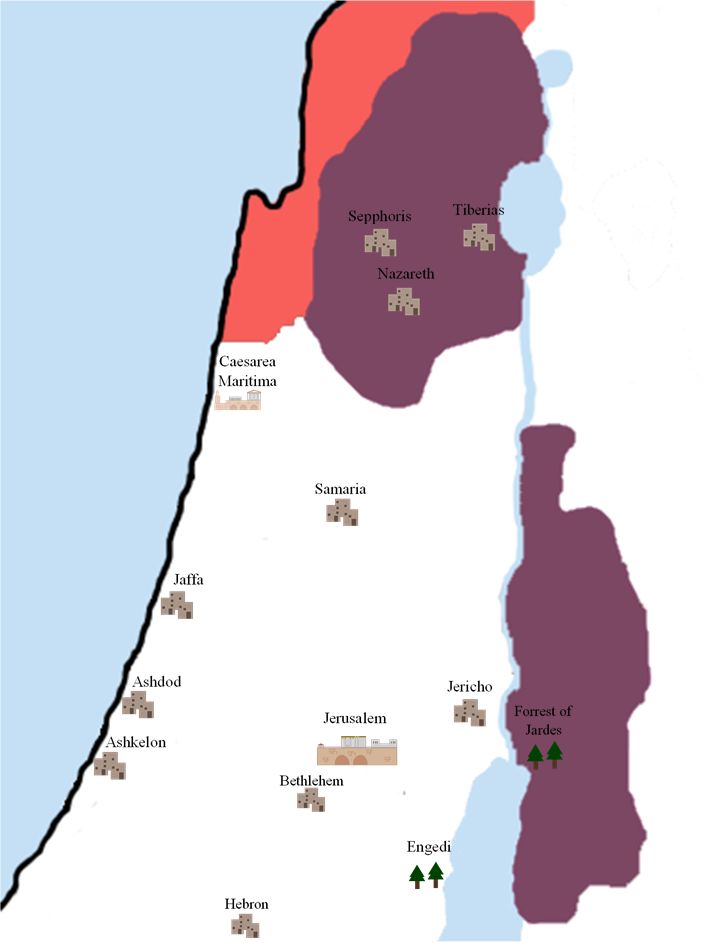
Jesus’ attitude to Herod Antipas, son of Herod I, was one of contempt.
Some friendly Pharisees told Jesus that Herod wanted to kill him. Jesus replied, ‘Go tell that fox, Listen, I am casting out demons and performing cures today and tomorrow, and on the third day I complete it all.’ (Luke 13.32).
His view of the government comes in two short descriptions: “What then did you go out to see? Someone dressed in soft robes? Look, those who put on fine clothing and live in luxury are in royal palaces.” (Luke 7.28)
“Among the Gentiles those whom they recognise as their rulers lord it over them, and their great ones are tyrants over them. But it is not so among you.” (Mark 10.42)
I once read through the Gospel of Mark sitting on the terrace of the Church of the Beatitudes, overlooking the Sea of Galilee. I could trace almost of all of Jesus’ journeys through the countryside laid out below me. Just five miles away was Tiberius, the city which Herod built. It was clear that Jesus never made the short 2 hour walk to visit it.
When he finally was standing before Herod on the morning of Good Friday, he said nothing. He refused to get into any kind of political game.
‘When Herod saw Jesus, he was very glad, for he had been wanting to see him for a long time, because he had heard about him and was hoping to see him perform some sign. He questioned him at some length, but Jesus gave him no answer.’ (Luke 23.8-9)
THE TEMPLE
The one openly political act of Jesus took place a few days before his death.
‘Jesus entered the temple courts and began driving out those who were buying and selling there. He overturned the tables of the money changers and the benches of those selling doves, and would not allow anyone to carry merchandise through the temple courts.’ (Mark 11.15-16)
The last sentence is usually forgotten. But it is crucial. What Jesus instigated was not just a demonstration but a takeover.
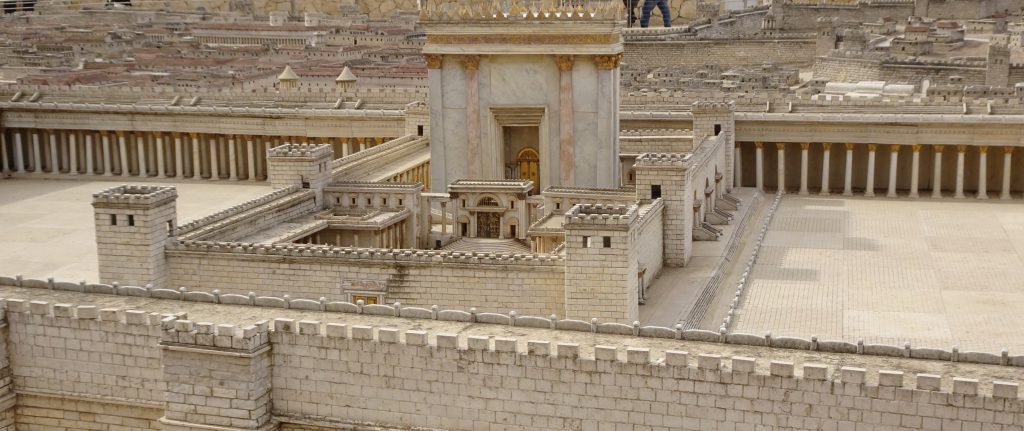
The temple had the only eastern gateway in Jerusalem. If you wanted to go east from the Upper City, you would go across a bridge, through the Royal Porch, across the Court of the Gentiles and out through the eastern gate. The only way for Jesus to interrupt the trade traffic was to have enough of his supporters at each of the gates to outnumber the Temple police. And it continued the next day. It was then the chief priests and elders asked, “By what authority are you doing these things?” – present tense, Mark convinces me that during that Passover week, while Jesus was alive, he was in control of the Outer Court of the Gentiles – a direct challenge to the Sanhedrin and Temple establishment. Because of the million plus pilgrims in and around the city that week, the chief priests were helpless. No wonder they wanted Jesus put out of the way.
“Beware of the scribes, who like to walk around in long robes, and to be greeted with respect in the market-places,and to have the best seats in the synagogues and places of honour at banquets!They devour widows’ houses and for the sake of appearance say long prayers. They will receive the greater condemnation.” (Mark 12.38-40)
A SOCIAL PROGRAMME?
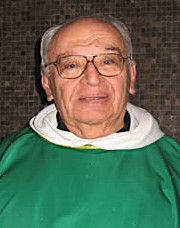
In 1971 a Peruvian theologian Gustavo Gutierrez published ‘A Theology of Liberation’, a key text in the development of Liberation Theology. It called the Church to ‘active participation to liberate humankind from everything that dehumanises it and prevents it from living according to the will of God.’ This means confronting unjust structures, often using Marxist analysis to understand what is actually going on behind the surface of events.
Popes who disliked it were John Paul II and Benedict XVI. Popes who supported it were Paul VI, Francis and Leo XIV. What was Jesus’ attitude?
Jesus always stood on the side of the poor. When he saw people making donations to the temple, he particularly praised a poor widow who just put in two farthings.
But he had no political programme about it. Instead of supporting a political revolution like the Zealots, he created a community which welcomed everyone, tax collectors and Zealots. Like the Pharisees, he wanted a purified religion and did not want to get involved in political movements.
CONCLUSION
Jesus did not live in a representative democracy. He lived in an autocracy. Except that the Sanhedrin and the Temple establishment were meant to promote the welfare of Israel. Jesus political views can be summed up in five points:
1. He had no views one way or another about Roman rule.
2. He had nothing but contempt for Herod Antipas who ruled Galilee quite well for 43 years.
3. He had no truck with violent movements. Instead of demonising some people, he wanted to include them in his new community, witness the tax collectors Levi and Zacchaeus.
4 He honoured the poor as those closest to the kingdom of God. And he attacked wealthy religious leaders verbally, implicitly demanding a change of heart and wallet.
5 He called for the Temple to be a place of spiritual integrity. “Is it not written, ‘My house shall be called a house of prayer for all the nations’?
But you have made it a den of robbers.” (Mark 11.17)
His guiding principle was to follow the will of his Father, who ‘makes his sun rise on the evil and on the good, and sends rain on the righteous and on the unrighteous.’ (Matthew 5.45)


0 Comments