
GETTING TO GRIPS WITH MARY
A BIBLE STUDY
Very many years ago I used to host a weekday Bible study in a shared flat in Earls Court. One evening I suggested we might do a Bible study on Mary. There was an almost audible hiss of indrawn breath as half dozen young evangelical Christians wondered if I had gone over to Rome. I chose the first two chapters of Luke and at the end everyone agreed what an inspiring time we had had.
Coming to the present, my wife thinks I give Mary a bit of a hard time. This is because I am basically a historian, so my first questions are always: ‘Did it happen?’ and ‘What’s the evidence?’ So this is an opportunity to think a bit more.
TOO MANY ASSUMPTIONS
Wednesday Saints
Every week since Covid lockdown I hold a short service on Zoom remembering a saint of the week. About half a dozen people take part and it is interesting and enlightening. On 13th August we celebrated Mary, the mother of Christ. It was just two days before the actual feast of the Assumption on Friday. We sang ‘The angel Gabriel from heaven came…’
We said the Magnificat (Luke 1.46-55) and had a reading from Galatians: ‘When the fullness of time had come, God sent his Son, born of a woman, born under the law, in order to redeem those who were under the law, so that we might receive adoption as children.’ (Galatians 4.4-5)
Everyone appreciated it.
At the monastery
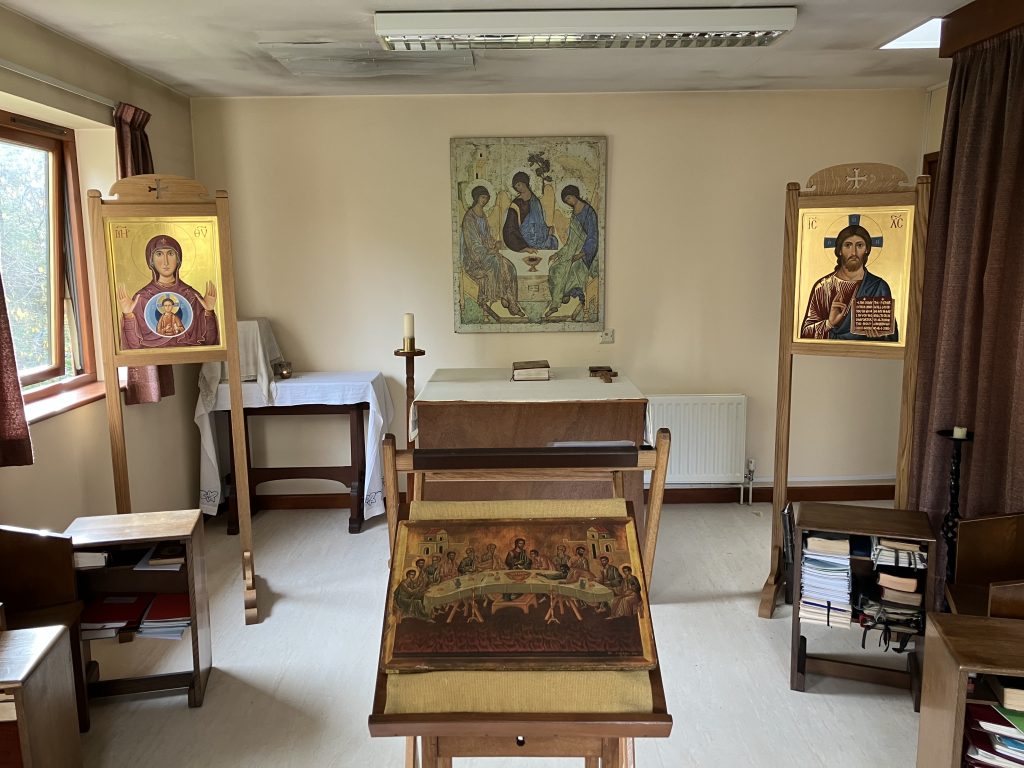
I then went for a couple of days retreat at the Monastery of the Holy Trinity in Crawley Down, Surrey. I have been going there for over thirty years. At their two main services, Lauds (7.00 am ) and Vespers (6.45 pm) they include this short Orthodox hymn to Mary:
‘It is indeed right to bless you Mary, the most pure and ever-blessed Mother of Christ our God. More honourable than the cherubim, and above compare more glorious beyond compare than the seraphim,who while remaining a virgin gave birth to the Word of God; we sing praises to you.’
The following day was the actual feast of the Assumption. In the evening the Divine Liturgy was celebrated (i.e. Holy Communion, Eucharist, Lord’s Supper etc.) with candles, incense and a long prayer of offering.
In Kensington
On Sunday morning I went to the Anglo-catholic church in our road for their short family mass. This was also about the Assumption of Mary. I then went to the lovely choral matins at St Mary Abbot in Kensington. Tthat was all about Mary too, because that is the church’s patronal festival. Five times in five days! Perhaps God was telling me something.
WHAT IS THE ASSUMPTION?
At the Council of Chalcedon in 451 the emperor Marcian wanted to have the body of Mary transferred to Constantinople. Juvenal, bishop of Jerusalem, said “that Mary died in the presence of all the Apostles, but that her tomb, when opened upon the request of St Thomas was found empty; so the Apostles concluded that the body was taken up to heaven.”
(St John of Damascus, quoting the Euthymiaca Historian)
The belief that Mary had proceeded straight to heaven is recorded in fourth century and possibly third century writings. The Eastern Orthodox Church calls the feast the Dormition or Falling Asleep of Mary. Mary died, and some days after her body was resurrected
In the West they called the Feast was the Assumption, i.e. Mary’s body being assumed directly into heaven. Different traditions arose. Did she go to heaven without dying, like the prophet Elijah? (2 Kings 2) Or did she die and her soul go immediately to heaven? Or was the physical body assumed into heaven after an interval?
Early Tradition
The oldest tradition is that she died in Jerusalem, having lived there with a Jerusalem disciple called John. An angel told her that she would die in three days, to allow time for the apostles to gather for her funeral. She must have been about 55 when Jesus was crucified. Guessing that she died around the age of 70, that would have been about 50 AD. Her second son James/Jacob was martyred in 62 AD.
What is certain is that the Feast of the Dormition was proclaimed by the Byzantine emperor Maurice in 600 and adopted in the west fifty years later.
Pope Nicholas 1 (858 – 867) put it on a par with Christmas and Easter.
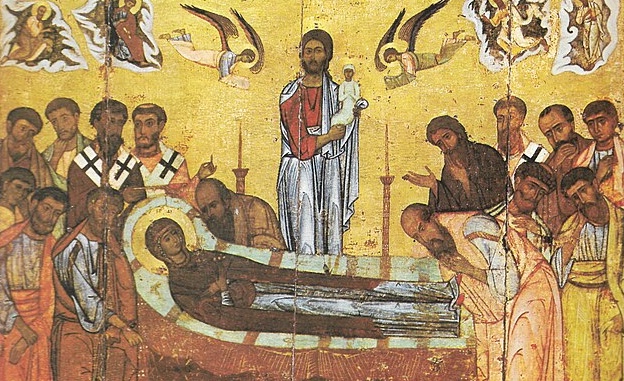
The Tomb of Mary
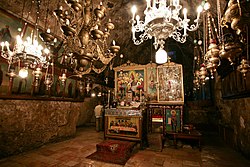
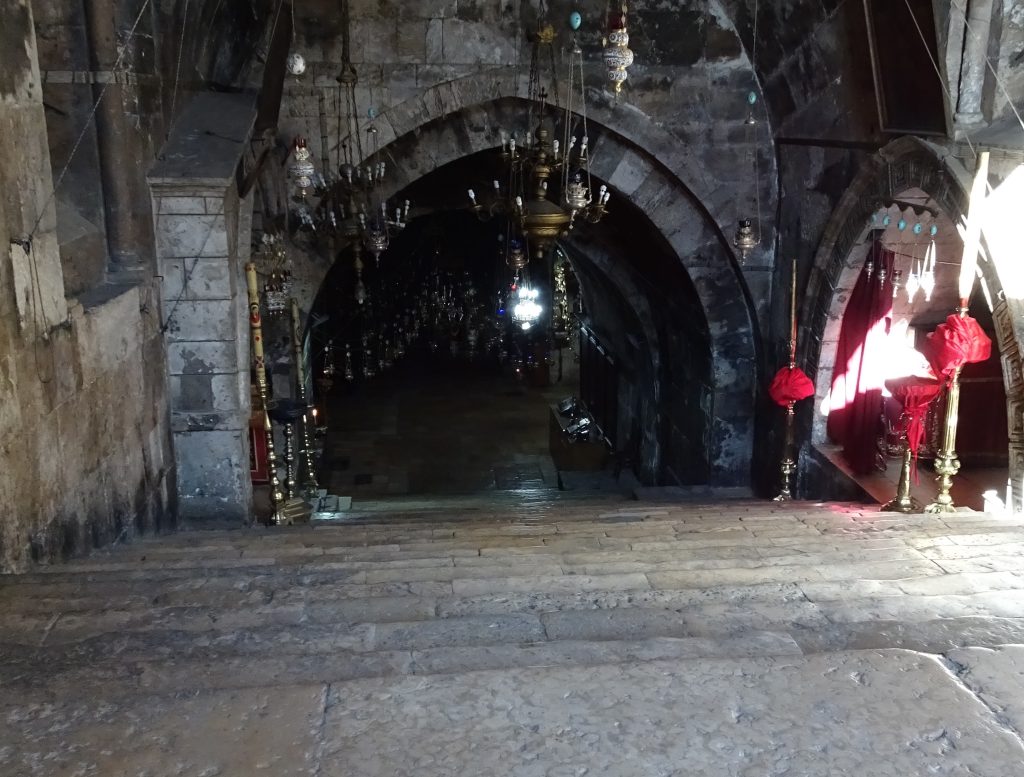
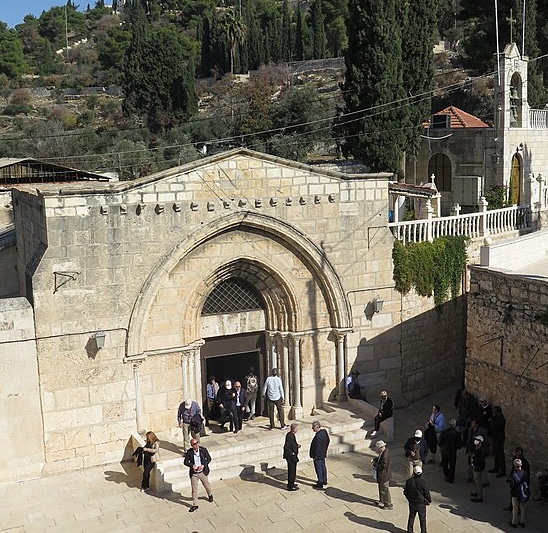
A monument was erected in the 5th century but destroyed in 614. The facade is from the time of the Crusades. You go down 47 very wide steps into the dim interior, arriving at the site of a 1st century rock-cut tomb. It is a place of extraordinary spiritual presence. I could well imagine that it was exactly here that the first Christians buried the mother of their Lord, using one of the rock-tombs in the Jewish cemetery by the river Kidron.
The Dogma
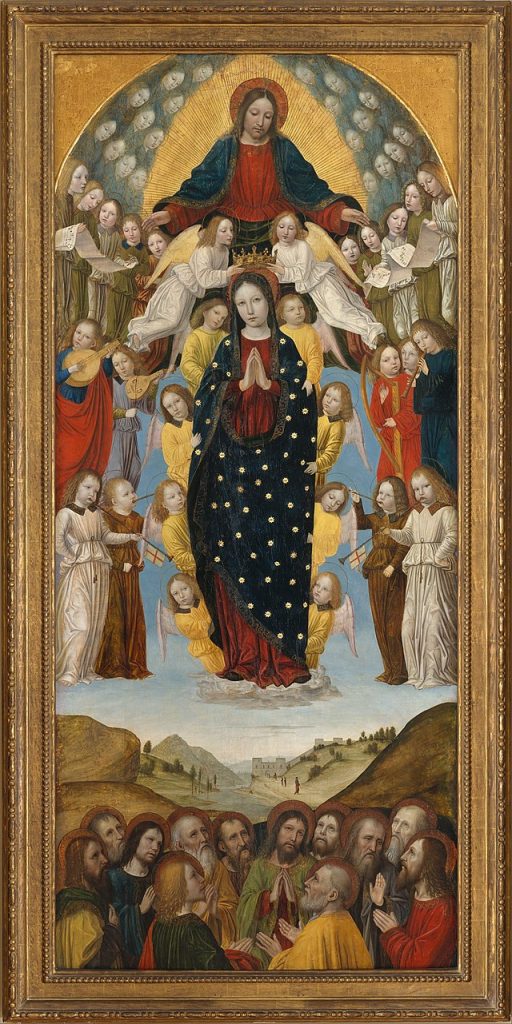
From 1849 the Papacy received several requests to make the Assumption of Mary a dogma of the Church. Using the image of a tree, this would make it part of the trunk, a belief that was mandatory, instead of a branch, which could be believed or not. In 1946 Pope Pius XII sent to all the bishops the following question:
“Do you, venerable brethren, in your outstanding wisdom and prudence, judge that the bodily Assumption of the Blessed Virgin can be proposed and defined as a dogma of faith? Do you, with your clergy and people, desire it?”
The answer was a unanimous ‘Yes’.
So on 1st November 1950 Pope Pius XII proclaimed in ‘Munificentissimus Deus’ that the Virgin Mary was transported soul and body directly in to heaven, either before or after she actually died: ‘The Immaculate Mother of God, the ever Virgin Mary, having completed the course of her earthly life, was assumed body and soul into heavenly glory.’
Feast day
15th August is the feast day, but it has various names indifferent churches. The Orthodox churches call it ‘the Dormition or Falling Asleep of the Blessed Virgin Mary’, the day she ‘fell asleep’ or died. It commemorates her natural death, one that was easy as she was so close to God.
Roman Catholics call it ‘the Assumption of the Blessed Virgin Mary’. They celebrate not so much her death as the physical taking of her body into heaven. They see this as a promise of a resurrection which all the faithful can look towards.
Anglicans and Lutherans call the day simply ‘the Blessed Virgin Mary’. The gospel reading is the Magnificat, the song of Mary, Luke 1.46-55.
THE EARLIEST VENERATION OF MARY
The first reflections on Mary come in the second century when Justin Martyr (c.155) and Irenaeus (c.180) both refer to Mary as ‘the new Eve’. In Luke 1.38 she says to the angel, “Here am I, the servant of the Lord; let it be with me according to your word.” Just as the original Eve’s act of disobedience led to the condemnation of humankind, so Mary’s act of obedience opened the door for the salvation of humankind.
The earliest prayer to Mary that we come across is in Egypt round about 250 AD. “Under your protection we seek refuge, Holy Mother of God.”
A split grew between the church of Egypt based in Alexandria and the Syrian church based in Antioch. The Egyptian church tended to stress the divinity of Christ and the Antiochene church the humanity of Christ. So Cyril of Alexandria insisted on the title of ‘Theotokos’ for Mary, ‘God-bearer’, while Nestorius of Antioch championed ‘Christotokos’, Christ-bearer.
Cyril wrote a public letter to Nestorius which ended, “[The Fathers] ventured to call the holy Virgin the Theotokos not as if the nature of the Word or his divinity had its beginning from the holy Virgin, but because of her was born that holy body with rational soul, to which the Word being personally united is said to have been born according to the flesh.”
The Antiochene theologian Theodore of Mopsuestia (350-428) said, “It is madness to say that God was born of the Virgin … It was not God, but the temple in which God dwelt, was born of Mary.” (It all gets rather convoluted).
The argument culminated in the frankly disgraceful Council of Ephesus in 431 in which Cyril won and Nestorius was excommunicated.
Although the term ‘Theotokos’ was meant to affirm the full divinity of Jesus Christ, the effect was to elevate Mary. From then on churches began to dedicated in her honour and her feasts spread throughout the Christian world.
WHY EGYPT?
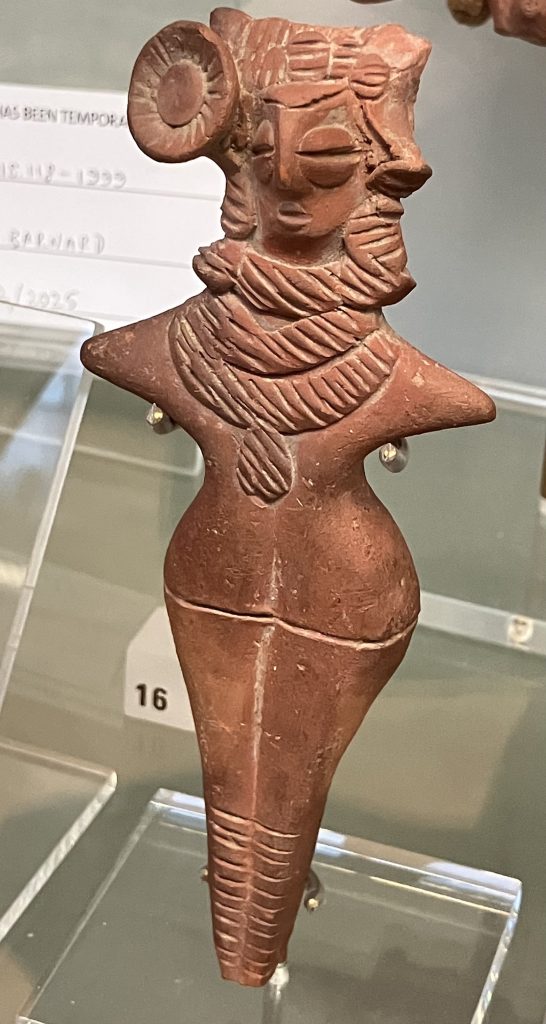
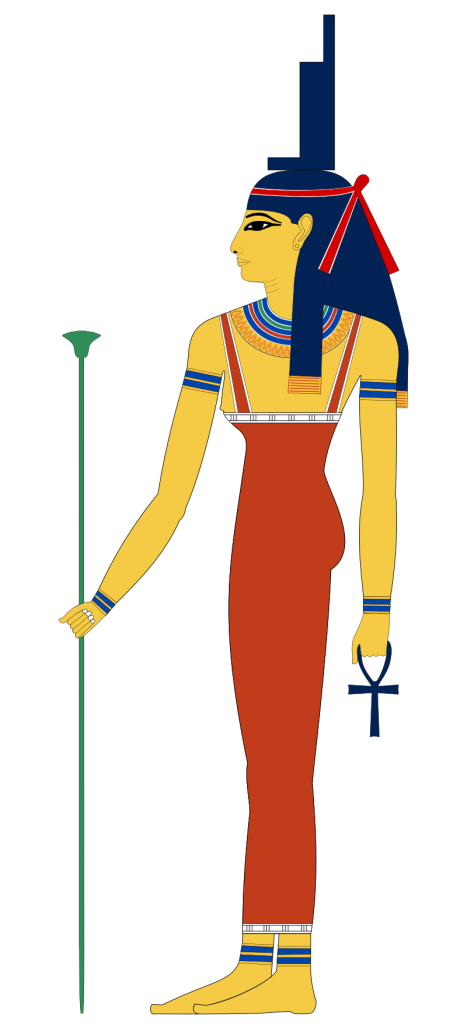
Why was Egypt the ‘ground zero’ of the veneration of Mary/Marian devotion? Was it because one of the most important of the 1400 gods of Egypt was Isis?
Isis was the wife of Osiris, whom she raised to life, briefly, after his murder by his brother Set. Isis conceived a son, Horus, by Osiris who then died again. At the time of Jesus both Egyptians and Greeks worshipped her and her cult became part of Roman religion with temples all over the Mediterranean. She was believed to help the dead enter the afterlife, could provide gifts of healing for people and supported marriage and ships at sea.
I doubt that there was any direct transfer of veneration from Isis to Mary. But I can see how the religious feelings of prayer and devotion which people centred on Isis could be carried over to Mary.
Sometimes the church did make such direct transfers. Near Canopus in Egypt there was a temple to the goddess Isis where healing cures took place. The Patriarch Cyril discovered the bodies of two martyrs, Cyrus and John, in St Mark’s church in Alexandria. He had the Christian martyrs reburied in the former temple to Isis, and the same healing miracles continued.
(J R Bury, A History of the Latter Roman Empire, vol 1 p.374)
OTHER DEVELOPMENTS
By 600 the main Marian feasts had been popularised throughout the church. Apart from the Dormition/Assumption these were:
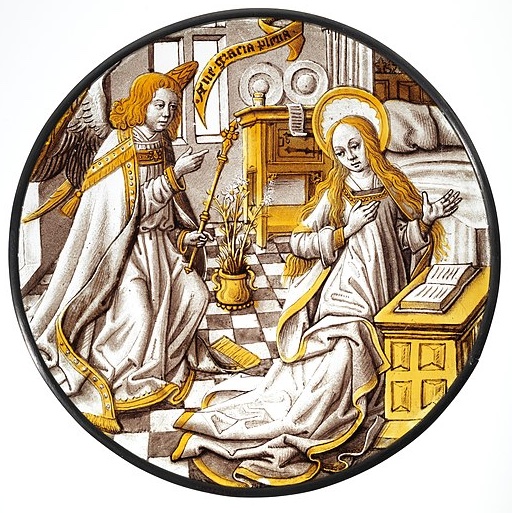
The Annunciation (25th March):
in which the Church remembered the message of the angel Gabriel to Mary and her obedient response. (Luke 1.26-38). Clearly there is good evidence for this, though Mary herself was probably dead by the time Luke was in Jerusalem (c.58-60) to collect material for his gospel. But her second son James/Jacob was still alive and in Jerusalem.
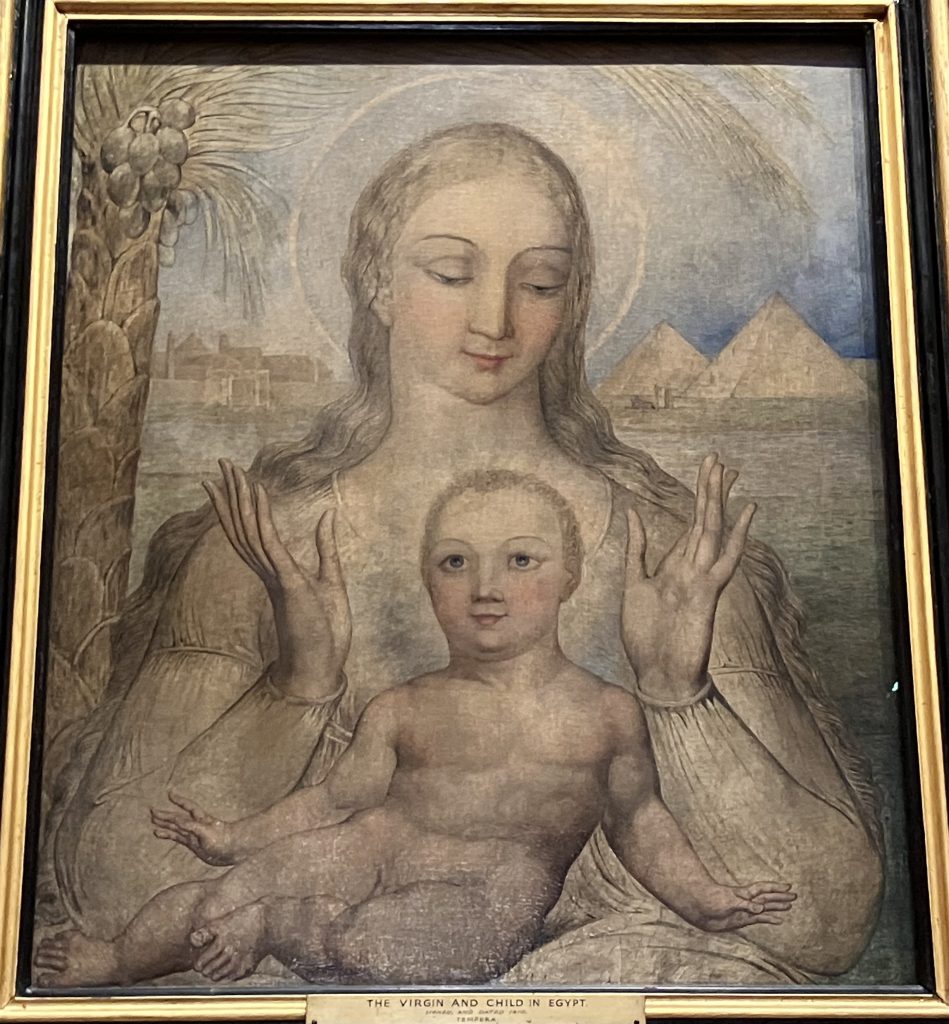
Lady Day
The monk Dionysius the Humble, (470-544) created the Christian calendar and made 25th March the start of the new year, because it was nine months before Christmas. March 25th became known as Lady Day; it was the beginning of the legal and fiscal year and the day when landowners made their annual contracts with tenant farmers. In 1752 Britain aligned itself to the Gregorian calendar, but lost 11 days in the process. However, Parliament did not want to lose 11 days of tax revenue, so they changed the start of the tax year to 6th April.
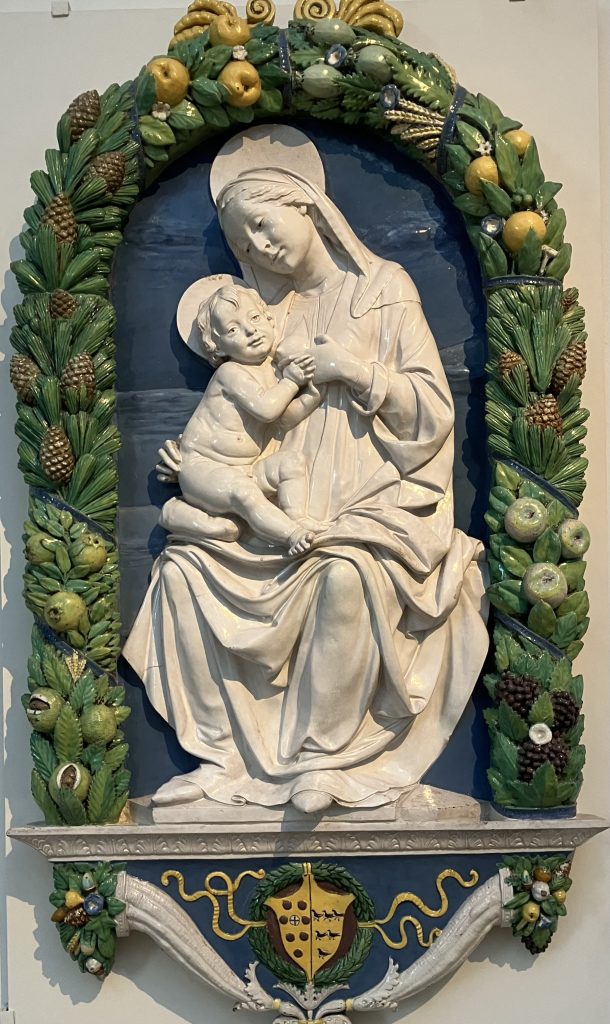
The Immaculate Conception of Mary (8th December):
The feast day began one celebrated its her 7th century and in England int eh 11th century. This was a highly contentious issue throughout the Middle Ages with Franciscan friars on one side and Dominican Friars on the other. The problem was that if Mary was born without sin and never sinned, was it necessary for Jesus to die as there was theoretically another way to salvation. The Council of Trent finally approved the feast of the Conception of Mary but without the word Immaculate. In 1854 Pope Pius IX finally proclaimed as a dogma that Mary was born immaculate, i.e. without original sin. The feast day is December 8th (Roman Catholic) or 9th (Orthodox).
The Nativity of Mary – Marymas (8th September) :
The Eastern Church celebrated teh birth of Mary in the 7th century and the Western church in the 8th. The feast day is 8th September, i.e. nine months after 8th December. Milan Cathedral was dedicated to the Nativity of St Mary in the 15th century.
APPEARANCES
- In 1061 a noblewoman, Richeldis de Faverches, received visions of Mary instructing her to build a replica of the Holy House of Nazareth. Walsingham rapidly became one of the most important pilgrimage destinations.
- In 1531 Our Lady of Guadeloupe appeared multiple times to a convert Juan Diego, her image appearing on his cloak.
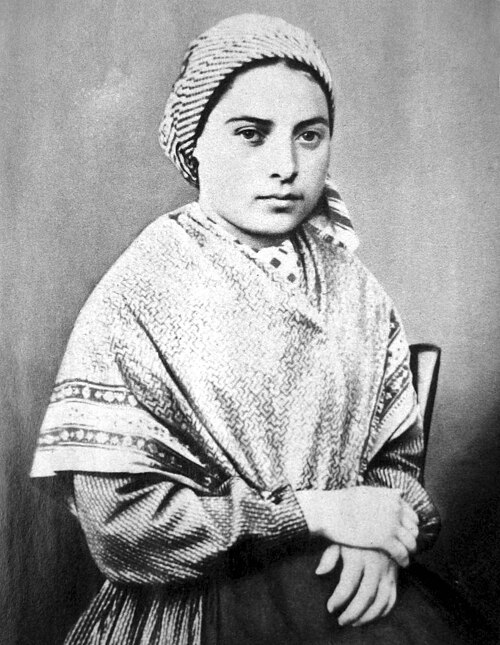
- In 1858 the 14-year old Bernadettee Soubirous saw Mary eighteen times in a grotto at Lourdes. Thousands of healings at the spring have been recorded.
- In 1879 a silent tableau of Mary, Joseph and St John the Evangelist with a lamb and an altar was seen on the church gable of Knock, Co. Mayo.
- In 1917 three shepherd children witnessed six apparitions of Our Lady of the Holy Rosary in Fatima, Portugal.
- In 1968 a luminous silent appearance of Mary was seen at Zeitoun, Cairo, and was witnessed simultaneously by Christians, Muslims and non-believers.
- In 1981 six Croat teenagers in Bosnia and Herzegovina saw a vision of the Lady (Gospa in Croat) and Mary gave them a series of messages. Medjugorje has become a major pilgrimage site.
The general attitude of the Roman Catholic Church, and mine, is that piety in important but piety is not proof.
MARY IN ISLAM
The Qur’an narrates the nativity of Mary, born from her father Imran and her mother Hannah. Hannah vows to dedicate her child to the service of God (Qur’an 3.31-33). In the Hadith there is a tradition that the only children to be born ‘without the touch of Satan’ were Mary and Jesus.
MEDITATING ON MARY
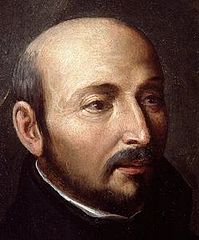
Around 1523 Ignatius of Loyola (1491-1556) wrote the Spiritual Exercises which became the cornerstone of Ignatian spirituality. A key component is a form of contemplation called ‘the application of the senses’.
For this you “place yourself in a scene from the Gospels. Ask yourself, “What do I see? What do I hear? What do I feel, taste and smell?” The aim is to enter into the scene in your imagination and find out what you find God or Jesus is saying to you.
At the end of the Eucharist/Liturgy at the monastery on Thursday evening, I thought back to how the Jerusalem church, who were all Messianic Jews, must have reacted when Mary died. They must have been really bereft, almost as if their own mother had died. In the case of James, the leader of the Jerusalem church, his mother had died. The burial would have been no clandestine affair, but a solemn community-wide outpouring of grief and faith. I could feel what honour they held her in, and how the Jerusalem community would have worshipped in both grief and hope. I imagine them singing that wonderful early Christian hymn we call the Magnificat (Luke 1.46ff):
‘My soul magnifies the Lord,
and my spirit rejoices in God my Saviour,
for he has looked with favour on the lowliness of his servant.
Surely, from now on all generations will call me blessed.’
ILLUSTRATIONS
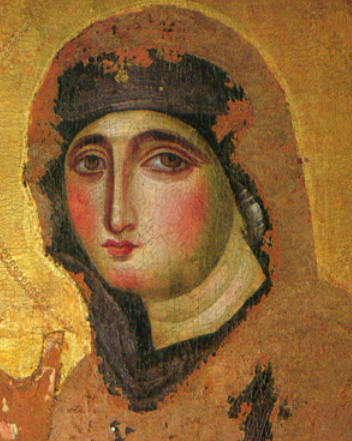
1 The earliest icon of Mary, 6th century (W)
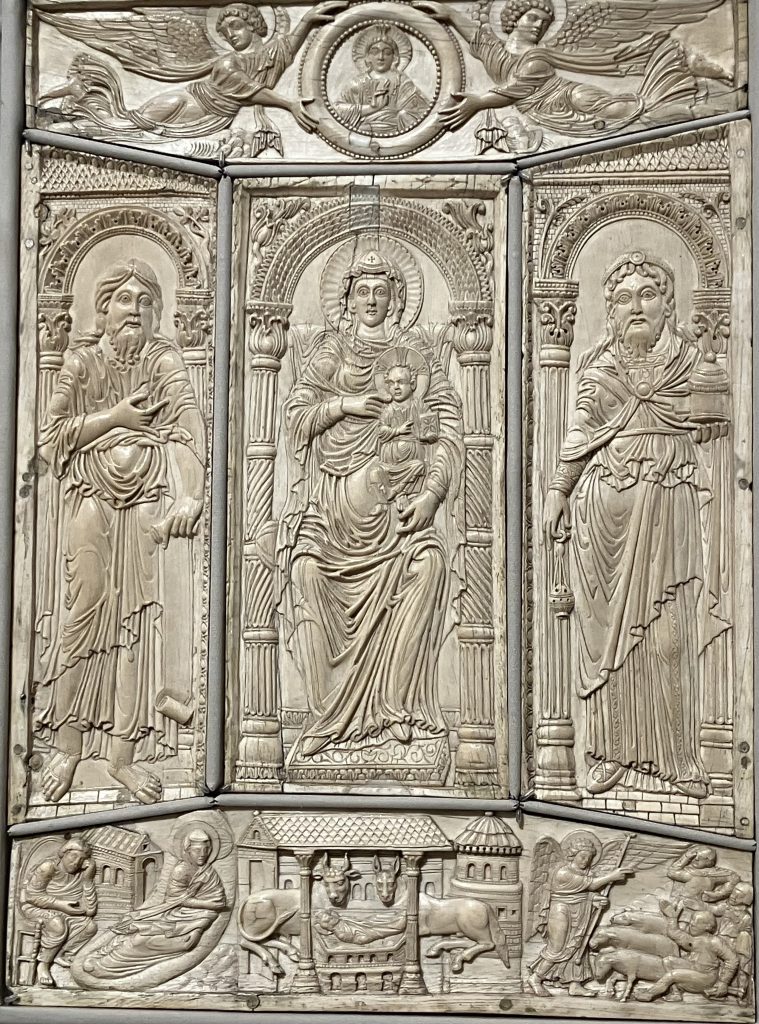
2 *Ivory cover of Gospel book c.800, Mary in centre.
3. Temporary chapel of teh Monastery fo teh Holy Trinity, Crawley Down
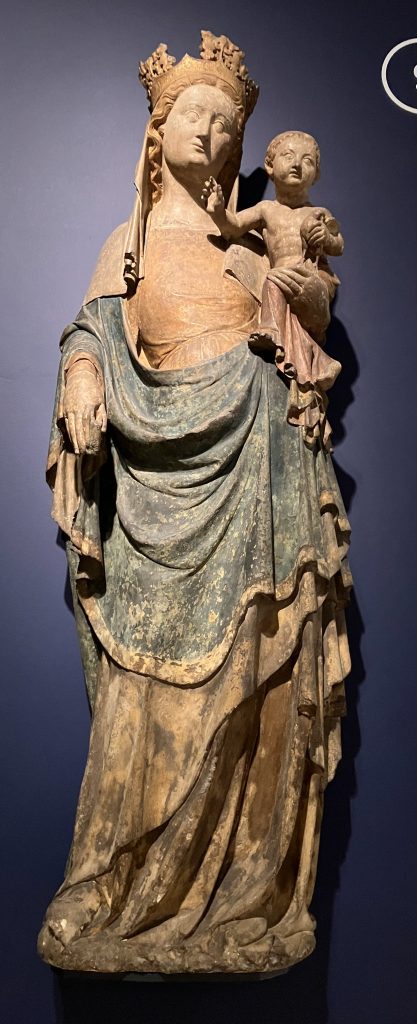
4 *Statues of Mary, France, 1340-1350.54 Icon of the Dormition of the Mother of God, Russian 12th century. (W) Jesus is holding Mary’s soul in his hand.
5, 6 Tomb of the Virgin Mary, Jerusalem – my photos
7 The Assumption of the Blessed Virgin Mary, 15th century. (W)
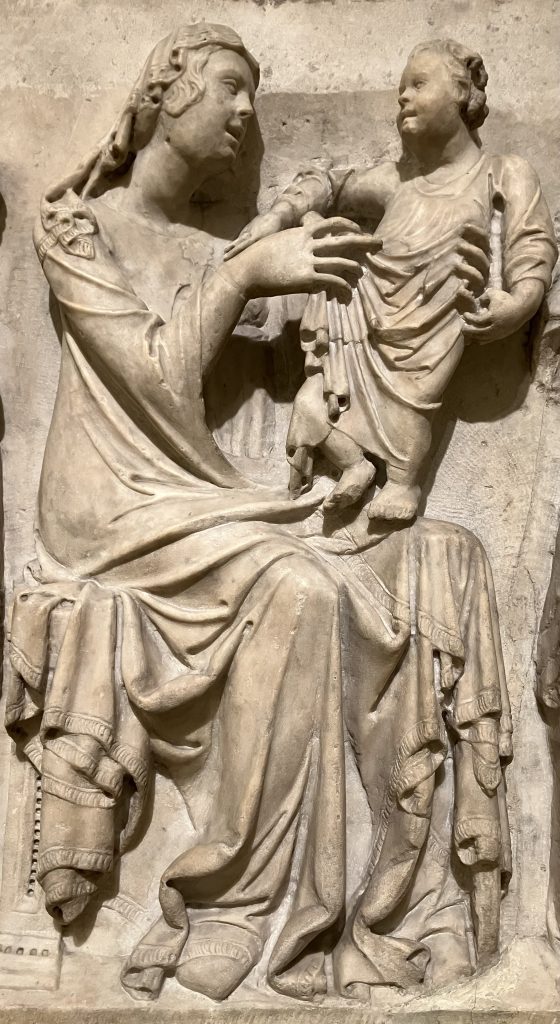
8 *Virgin and child, Italian 1315-1336
9 *Small clay image of a mother goddess, 100 BC-100 AD, Gandhara, Pakistan
10 Composite picture of Isis, (W)
11 Glass roundel of the Annunciation, South Netherlands c.1500. http://www.metmuseum.org/art/collection/search/471962
(W)
12 *Virgin and child, William Blake
13 *Madonna and child, Florence, Andrea della Robbia, 1478-1488
14 Ignatius de Loyola, 1491-1556, 16th century portrait. (W)
15 12th century facade to the Tomb of Mary, Jerusalem. (W)
* My photos take-in the Victoria and Albert Museum
(W) from Wikimedia Commons


0 Comments